Drywall finishing separates the amateurs from the skilled DIYers, and your tool choice matters more than you might think. If you’ve tackled a drywall repair or full wall installation, you know that sanding clouds, joint compound cleanup, and precision cuts eat up hours without the right equipment. DeWalt drywall tools have earned a solid reputation among homeowners and pro installers alike for their reliability, durability, and ability to actually get the job done without burning out halfway through a project. This guide walks you through the essential DeWalt drywall tools that’ll transform your finishing workflow, from taping and sanding to cutting and fastening, so you can spend less time wrestling with subpar equipment and more time enjoying your finished walls.
Table of Contents
ToggleKey Takeaways
- DeWalt drywall tools are engineered for precision and durability, with built-in dust collection and reliable fastening systems that deliver professional results for DIY drywall projects.
- A quality DeWalt orbital sander like the DWE6423K prevents overheating and clogging while handling long runs without vibration, making it essential for achieving smooth wall finishes.
- DeWalt’s battery ecosystem allows you to use multiple drywall tools with the same 18-volt or 20-volt batteries, reducing overall equipment costs and simplifying your toolkit.
- Proper surface preparation, including adequate humidity acclimation and precise joint compound application, is more critical than tools alone—invest time in these steps to minimize sanding and rework.
- Dust management with a shop vacuum and proper respiratory protection is non-negotiable when sanding drywall, as joint compound contains silica that poses cumulative health risks.
- A basic three-tool setup—orbital sander, screw gun, and drill-driver—handles approximately 80% of drywall finishing work and provides the foundation for professional-quality results.
Why Choose DeWalt for Your Drywall Projects
DeWalt built its name on reliability, and their drywall-specific tools prove it. Unlike generic power tools, DeWalt’s drywall lineup is engineered for the repetitive, precision-heavy work that finishing demands. Their sanders handle the abrasive grit without bogging down, their saws cut clean without tearout, and their fastening systems seat screws at the right depth, every time.
DIYers often ask whether pro-grade tools are worth the premium. For drywall work, the answer is yes. A cheap orbital sander will overheat and clog after thirty minutes on a 12-foot wall: a DeWalt DWE6423K pushes through without hiccup. You’ll also find parts in stock at most big-box retailers and rental centers, which matters when a bearing fails on a Saturday morning. Plus, DeWalt’s warranty coverage gives you peace of mind on tools you’ll use repeatedly. Tools with dust collection built in (and actually effective dust collection) save hours on cleanup, which is no small thing when joint compound gets into everything. Finally, many DeWalt drywall tools work with the same 18-volt or 20-volt battery ecosystem, so if you already own a DeWalt drill or circular saw, you’re not starting from scratch.
Essential DeWalt Drywall Taping Tools
Taping (applying joint compound and embedding tape) is where drywall quality lives or dies. Most drywall failures aren’t structural, they’re cosmetic bumps, creases, and tape shadows that come from rushed or imprecise taping. DeWalt’s taping lineup focuses on speed without sacrificing finish.
The DeWalt DCD776C2 is a compact drill-driver that works brilliantly for fastening drywall anchors and pre-drilling pilot holes before taping seams. Its 18-volt platform is light enough for overhead work, and the torque control prevents over-driving fasteners into soft drywall. Pair it with a depth-adjustable drywall bit (often sold separately) to seat screws flush without dimpling. For compound mixing, a DeWalt-compatible paddle mixer (like the DW130V) saves your wrist and ensures uniform consistency, lumpy compound shows every bump under primer.
If you’re doing a bedroom or two, hand taping is fine. If you’re finishing a basement or a kitchen renovation, you’ll thank yourself for investing in a taping banjo or compound applicator. DeWalt’s oscillating multi-tool kits (with the right attachment) can help feather edges faster than a putty knife, though purists argue a steady hand beats gadgets every time. For most DIYers, a reliable drill, a quality mud pan, and a set of 12-inch and 6-inch taping knives matter more than fancy compound applicators.
Drywall Sanders and Polishers
Sanding is the least fun part of drywall finishing, and the most critical. Dust control and even pressure make the difference between a silky-smooth wall and one that eats primer.
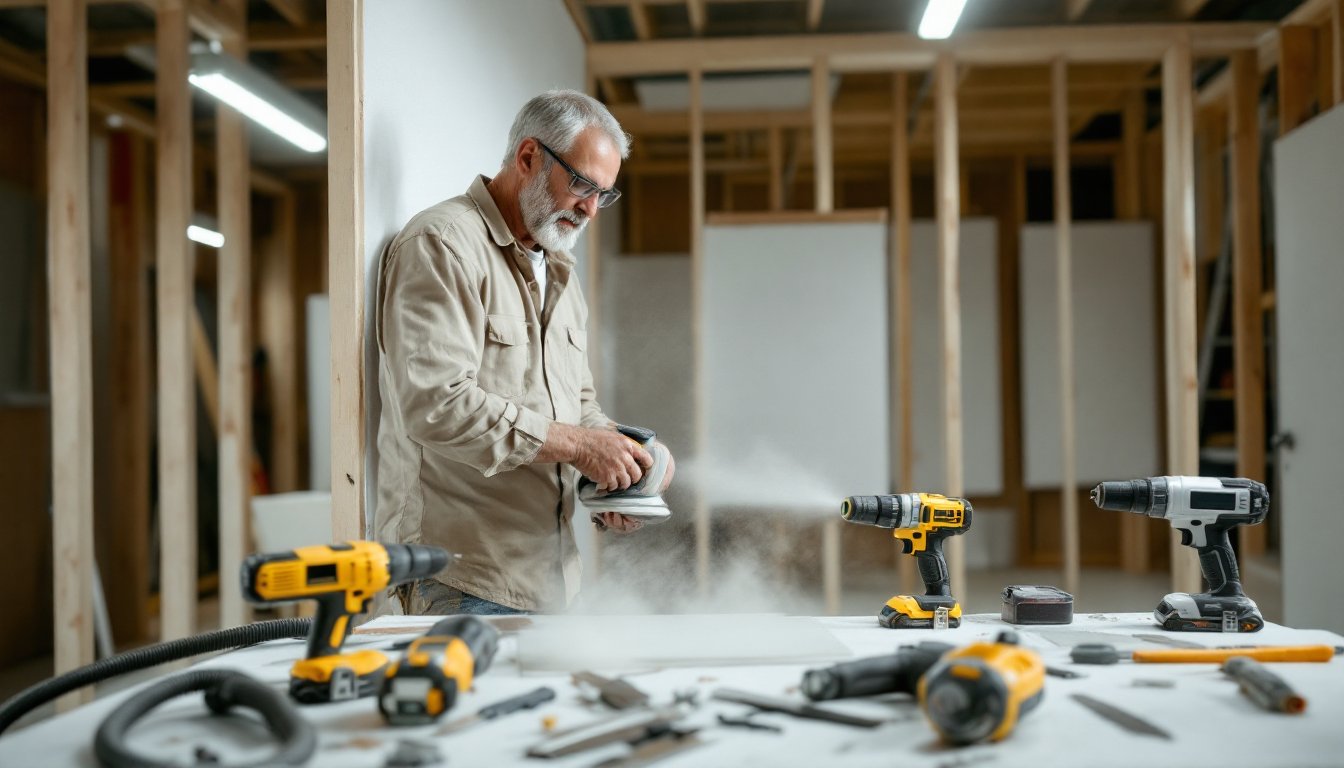
The DeWalt DWE6423K is the go-to orbital finishing sander for drywall. Its 5-inch pad uses standard adhesive-backed sanding discs (80, 120, 150, 220 grit), and it handles long runs without vibration fatigue. The dust-collection port connects to a shop vac, which is essential, skip the bag attachment and you’ll inhale joint compound particles for weeks. On an 8-foot ceiling, this tool won’t gouge or leave circular marks if you keep it moving and let the sandpaper do the work.
For large expanses (like finished basements), consider renting or buying a pole sander with a dust shroud. DeWalt makes attachments that work with their drill platforms, though a dedicated pole sander is still faster and easier on your back. A 120-grit or 150-grit sanding sponge (used with light hand pressure) is also worth keeping around for detail sanding around light fixtures and corners, places where orbital sanders can’t reach safely. Always wear a P100 respirator or half-mask with drywall-rated cartridges when sanding: joint compound dust is silica-based and cumulative. Goggles and hearing protection aren’t optional either, especially in enclosed spaces where dust clouds get dense.
Cutting and Installation Tools
Drywall cutting accuracy prevents wasted material and messy callbacks. A straight edge and utility knife work for simple cuts, but they leave rough edges that require more finishing. Power tools speed up the process and improve edge quality.
The DeWalt DCS391B is a compact 6-inch circular saw that excels at straight crosscuts on drywall sheets. It’s light, handles vertical cuts on walls without fatigue, and produces a cleaner edge than a handsaw. For notches (around outlets, windows, or HVAC vents), a jigsaw or oscillating multi-tool is more precise. DeWalt’s jigsaw models (like the DCS331C1) cut curves without binding and handle the dusty environment that drywall creates.
Building codes (IRC and NEC, though they vary by jurisdiction) specify minimum fastener spacing and joint compound thickness. Most installers use drywall screws (1¼ inches for ½-inch drywall on studs spaced 16 inches on center) and spacing of 12 inches on field runs and 8 inches on perimeter. A screw gun or drywall driver, like the DeWalt DW275D, automates fastening and prevents over-driving. The depth clutch stops the screw at the right dimple depth, which is critical because over-driven fasteners weaken the board and create future problems under paint.
Drywall Saws and Accessories
A drywall saw (also called a keyhole saw) cuts outlet and fixture holes freehand without pre-drilling. DeWalt’s oscillating multi-tool with a metal-cutting blade does this job efficiently, or a manual drywall saw costs $15 and requires zero power source. For larger openings (like a pass-through from kitchen to living room), a reciprocating saw with a drywall blade works, though you’ll need precise layout to avoid hitting studs.
For edge finishing, a drywall rasp or surform tool smooths rough saw cuts before taping. A utility knife with snap-off blades (preferably a model with a locking mechanism to prevent accidental blade drops) is non-negotiable for trimming excess compound, cutting tape, and score-and-snap operations. Keep blades sharp: dull blades tear compound and tape instead of cutting cleanly. Resources like Today’s Homeowner and This Old House offer detailed guides on drywall installation techniques and code compliance across different regions, so always verify local requirements before starting a major project.
Consider pairing your DeWalt power tools with a quality work light, drywall finishing is detail work, and shadows hide imperfections that show under primer and paint. A headlamp or clip-on work light ($20–$40) pays for itself in time saved on rework.
Power Tools That Speed Up Your Workflow
Beyond the basics, a few power tools multiply productivity. A battery-powered drill-driver (like the DeWalt DCD777D2) pre-drills pilot holes and drives fasteners at controlled speed, which is faster than hand tools and reduces wrist strain over long sessions. If you’re hanging drywall sheets (not just finishing existing walls), a screw gun automates fastening and prevents the hand fatigue that comes from driving hundreds of screws manually.
A shop vacuum with a fine-filter bag (or HEPA filter) connects to your sander and oscillating tool, containing the silica dust that’s notorious for coating every surface in a home. The DeWalt DWV010 10-gallon wet/dry vac is common in rental centers and pairs well with their power tools via standard hose connections. Joint compound dust gets into HVAC systems and automotive paint if left unchecked, so dust management isn’t optional, it’s a habit.
For a professional finish, invest time in surface prep before power tools. Drywall must be fully acclimated to the room’s humidity (typically 24 hours after hanging) before taping begins. Substrate preparation, filling voids, taping joints, feathering edges, determines whether you sand for two hours or eight. An essential workshop tools list will help you organize and plan your inventory, ensuring you’re not scrambling mid-project. For homeowners building out a best tool set for home projects, drywall-specific tools deserve a dedicated section alongside general carpentry and finishing gear. If you’re tackling drywall finishing for the first time, reviews of best drywall cutters provide context on how different brands compare and which tools solve specific problems.
Conclusion
DeWalt drywall tools combine durability, precision, and real-world reliability that justify their cost on any serious finishing project. Start with a good orbital sander, a screw gun, and a reliable drill-driver, those three tools handle 80% of drywall work. Add a compound mixer and dust collection, and you’ve got a system that works. Don’t skip safety gear or surface prep, and you’ll finish walls that look pro-built without the pro-size bill.